Jiuhuashan Mountain
Mt. Jiuhua lies 20km northeast of Qingyang County, Anhui Province and is a sacred place for Buddhist pilgrims. Mt. Jiuhua has been established as one of the four most important Buddhist Mountains and is well-known as "the most picturesque mountain in the southeast China". Famous for its beautiful scenery and favorable climate, the mountain is an ideal summer resort. The 100 km2 area is full of ridges and peaks, exotic-shaped stones, gushing fountains, roaring waterfalls, and clear streams. Birds accompany the beating of bell and drum. Fog and pines set each other off beautifully. 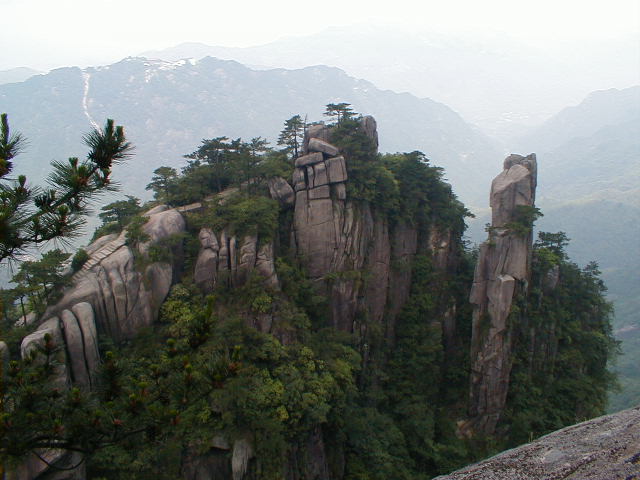
The original name of the mountain was Mt. Jiuzishan. However it was renamed Mt. Jiuhua, meaning "the Mountain of the Nine Lotuses." Legend states that one day, Libai - the famous poet of the Tang Dynasty - came to visit this mountain. The poet was intoxicated with the scene of nine peaks that look like lotus blooms from heaven. Out of admiration he wrote the lines: "From the azure skies above descends a jade-like flow, and nine fascinating lotuses rise out of the hills below." Since then the mountain has attracted men of letters through several dynasties, and thus obtained its fame. Just as the Chinese saying goes:" A mountain is famous not for its height but for its holiness".
Famous Buddhist Shrine
It was not until the late eighth century that the mountain became a place where religious rites were held to worship the God of Earth. The construction of temples started in the Tang Dynasty and their enlargement continued in the following dynasties. By the middle of the Qing, Mt. Jiuhua became one of the four great Buddhist Mountains in China (the other three being Mt. Emeishan in Sichuan, Mt. Wutaishan in Shanxi and Mt. Putuoshan in Zhejiang). 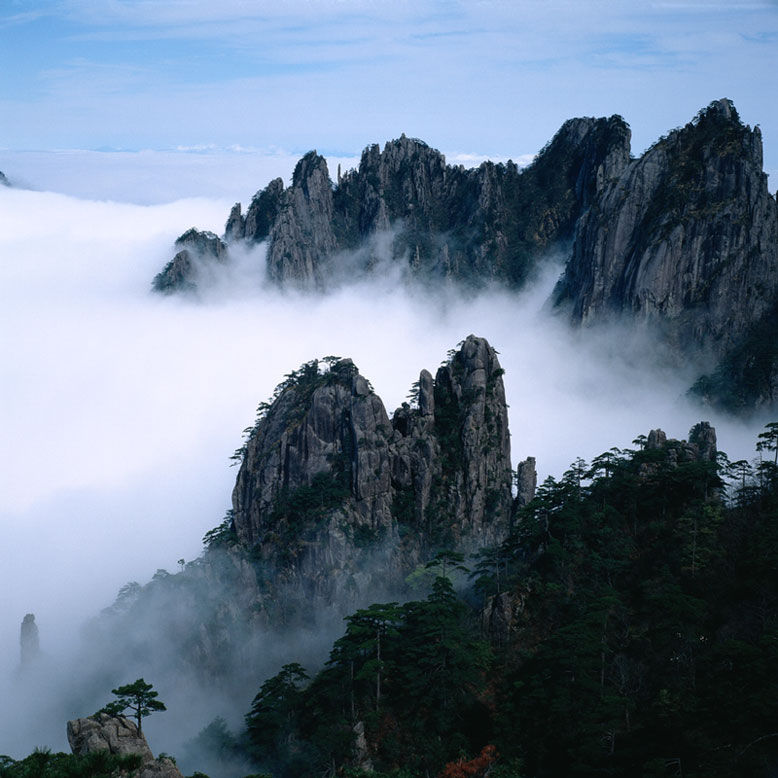
"Huacheng Temple" is the oldest temples on the mountain. It looks simple and solemn. Its lintels, brackets and roofs all have artistic engravings on them. The picture "nine dragons are playing with pearls" on a panel in the "Main Shrine Hall" is a consummate piece of ancient Chinese artists. Precious sutras and other cultural relics in Huacheng and other temples are on display in the Historical Relics Museum of the Jiuhua Mountain. The most valuable of all are the Buddhist canonical literature left from the Tang Dynasty, the Tripitaka left from the Ming Dynasty, and Emperor Kang Xi and Emperor Qian Long's handwritings left from the Qing Dynasty.
In the "Corporeal Body Hall" of Wannian Temple is the mummy of Monk Wu Xia, wearing a lotus-flower-shaped crown and a vermilion "kasaya," and is still well preserved after more than 350 years. Buddhist followers are keen to pay homage to the monk whenever they visit the Mountain. Other attractions include the "Corporeal Body and Treasure Hall," which houses the body of has eminent monk Jin Qiaojue's, and the splendid palatial architecture of Zhiyuan Temple. |
