Putuo Mountain, on an island off the eastern coast of Zhejiang Province, is one of the four Buddhist shrines in the country.
The mountain rises alone over the East China Sea. Sailing near, one can see verdant trees, strange rocks, mysterious temples, and huge inscriptions carved on stones. The mountain also has a stretching beach and a lot of caves, surrounded by floating clouds.
The mountain has numerous temples and nunneries, and is therefore called a "Buddhist Kingdom on the Sea". The principal temple -- Puji Temple -- with more than 200 halls built in the Tang Dynasty(618-907), is the largest of its kind in Southeast China. The main hall, which can hold some 1,00 people, has statues of Skt. Avalokitesvara in 32 incarnations. The five-storied quadrangular Duobao Pagoda(Rich Treasure Pagoda) to the east of Puji Temple was put up in the Yuan Dynasty(1271-1368) with stones from Taihu Lake in Jiangsu Province. The Fayu Temple, consisting of halls in six layers, is the second largest temple on the mountain and wasconstructed in the Ming Dynasty(1368-1644). Inside the temple,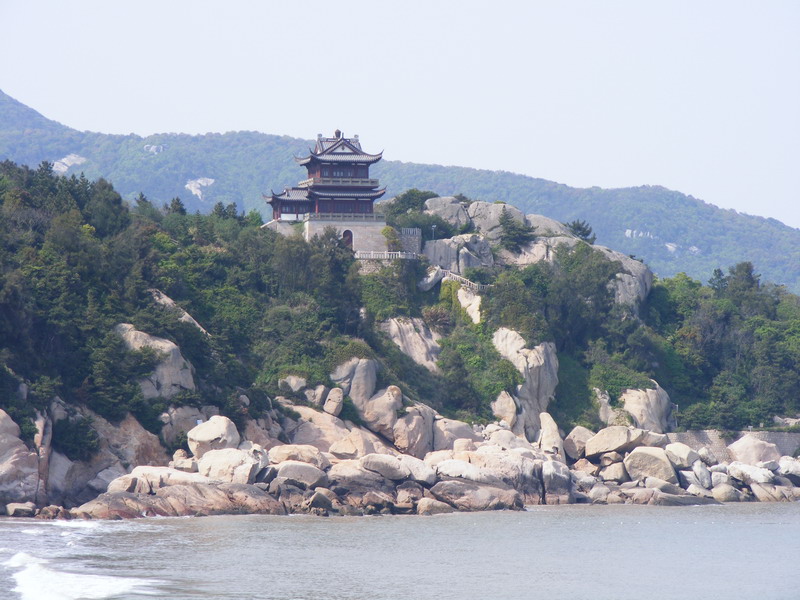 a sunk panel , with a huge bright pearl hanging from its center, is supported with nine rafters engraved with coiling dragons, which are depicted to try to get the pearl. Huiji Temple, built in the Ming Dynasty, is located on the top of Putuo Mountain. In front of the temple are some 1,000 stone steps. The temple, the third largest on the mountain, has four halls, seven palaces and six attics. Yueling Temple half way up the mountain has been turned into a museum, which keeps more than 1,000 pieces of precious historic relics, including imperial edicts and gifts from ancient emperors and empresses; gifts presented by the ninth Panchen living Buddha of Tibet; precious Buddhist relics from Japan, India, Burma, the Philippines and Kampuchea. a sunk panel , with a huge bright pearl hanging from its center, is supported with nine rafters engraved with coiling dragons, which are depicted to try to get the pearl. Huiji Temple, built in the Ming Dynasty, is located on the top of Putuo Mountain. In front of the temple are some 1,000 stone steps. The temple, the third largest on the mountain, has four halls, seven palaces and six attics. Yueling Temple half way up the mountain has been turned into a museum, which keeps more than 1,000 pieces of precious historic relics, including imperial edicts and gifts from ancient emperors and empresses; gifts presented by the ninth Panchen living Buddha of Tibet; precious Buddhist relics from Japan, India, Burma, the Philippines and Kampuchea.
Related books
|
|
